
Reviewed · WALKING TOURS
Sarajevo Walking Tour
Sarajevo tells its story on foot. In two hours, this guided walk strings together mosques, Ottoman caravan stops, and the spark of World War I, with mostly free entry tickets along the way.
I especially love the smart, specific details, like the Gazi Husrev-beys Mosque receiving electricity in 1898. I also like the oddball, unforgettable stop at the Old Sarajevo Clock Tower, where the clock keeps lunar time.
One thing to consider: each stop is brief, around 5 to 10 minutes, so you will need to keep pace if you want time for questions and extra photos. The group is capped at 30, which helps the guide keep things moving.
In This Review
- Key highlights worth showing up for
- Sarajevos big highlights, packed into a 2-hour walk
- Gazi Husrev-beys Mosque and the 1898 electricity fact
- Meeting of Cultures and the quick context that makes Sarajevo click
- Hidic coppersmith street, and why the souvenirs feel real
- Emperor’s Mosque from 1457, plus two mosques in one route
- Sebilj Fountain and Sarajevo City Hall, plus the moved-house story
- Morica Han, then the Old Sarajevo Clock Tower with lunar time
- Tašlihan caravanserai, then Latin Bridge and the WWI trigger
- The Museum of the Jews, and why oldest synagogue matters
- Vječna vatra Eternal Flame, the WWII liberation memorial
- Price, tickets, and what to budget beyond $12.10
- Who should book, and who might want a slower option
- Should you book this Sarajevo Walking Tour?
- FAQ
- How much does the Sarajevo Walking Tour cost?
- How long is the tour?
- Is the tour offered in English?
- Do I get a mobile ticket?
- Are any admission tickets included?
- Where does the tour start and end?
- What is the maximum group size?
- Can I cancel for a full refund?
Key highlights worth showing up for
- Electricity in 1898 at Gazi Husrev-beys Mosque, a real Sarajevo first
- Lunar time on a public clock, high up in the Old Sarajevo Clock Tower (about 30 meters)
- Old Sarajevo crafts at Hidic, with coppersmith work tied to nearly 500 years of tradition
- World War I at Latin Bridge, the spot where the triggering spark happened
- Ottoman travel stops at Morica Han and Tašlihan, built for merchants and caravans
- A WWII memorial at Vječna vatra, honoring those who liberated Sarajevo
A few more Walking Tours in Sarajevo
- Sarajevo: Grand Walking Tour Through Time and Cultures
★ 4.8 · 1,236 reviews - Sarajevo: 2 Hours Old Town Walking Tour With Local Guide
★ 5.0 · 505 reviews - Private Walking Tour, Food Tasting and Bosnian Coffee in Sarajevo
★ 5.0 · 255 reviews - Sarajevo Grand Walking Tour
★ 5.0 · 232 reviews
Sarajevos big highlights, packed into a 2-hour walk
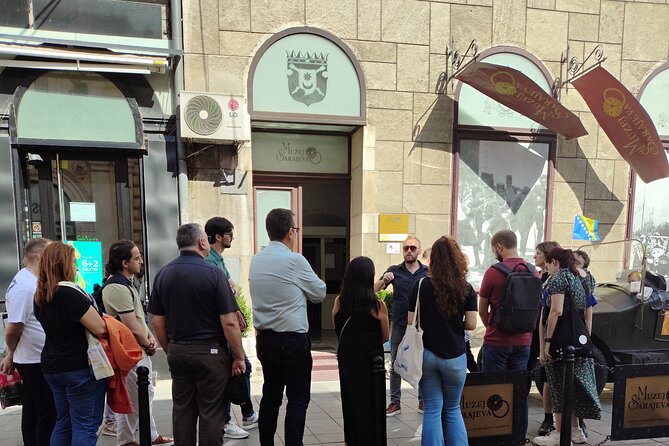
This is the kind of tour that helps you get your bearings fast. Instead of choosing one museum or one mosque, you stitch the city together step by step. You start at Vječna vatra (the Eternal Flame memorial), then you head into central old Sarajevo and circle through key landmarks on foot.
The price, $12.10 per person, is low enough that you can treat this as your “orientation walk.” A big part of the value is that the tour guide is included, and many stops list free admission. You are not paying your way into every sight, and that makes the tour feel like good spending, not just a ticket to walk in front of things.
The pace is brisk but not frantic. You will spend short bursts at each stop, usually 5 to 10 minutes, which keeps the route efficient. If you come to Sarajevo wanting lots of unhurried wandering, you might feel a little rushed. If you want context and a clean hit list of places to remember, it fits well.
Gazi Husrev-beys Mosque and the 1898 electricity fact
Your tour begins with one of the city’s anchors: Gazi Husrev-beg Mosque, described as Sarajevo’s central mosque. The standout fact here is wild in a good way, it was the first mosque in the world to receive electricity in 1898.
That detail matters because it changes how you see the building. You are not only looking at a historic house of worship. You are noticing how Sarajevo plugged in modernization while staying rooted in tradition. It is the kind of story that makes later stops make more sense, because the city’s past is not one-dimensional.
Practical tip: this is an early stop, so show up ready to look up and around. Even if you only get a few minutes inside the broader visit moment, the architecture and the setting do most of the work. Admission is listed as free here, so you are not juggling costs right away.
Meeting of Cultures and the quick context that makes Sarajevo click
Next you hit Sarajevo Meeting of Culture, a stop built for perspective. The key idea is simple: Sarajevo is where east meets west. Your guide’s job is to translate that into what you see around you, not just repeat a slogan.
I like this kind of stop because it stops you from pigeonholing the city. Sarajevo is not a single theme park of one era. It is a layered city where different influences leave traces. When the walking tour reaches mosques, caravan inns, and the later World War I site, that “meeting” framing helps you connect the dots instead of treating each location as a separate random postcard.
This one is short, only about 5 minutes. So treat it like a mental reset. Let the guide’s framing color the next places you visit, especially the craft street and the historic religious sites right after.
Another way to spend the day from here:
- Fall of Yugoslavia, Sarajevo War Tour with Tunnel of Hope Museum and Frontlines
★ 5.0 · 1,314 reviews

Hidic coppersmith street, and why the souvenirs feel real
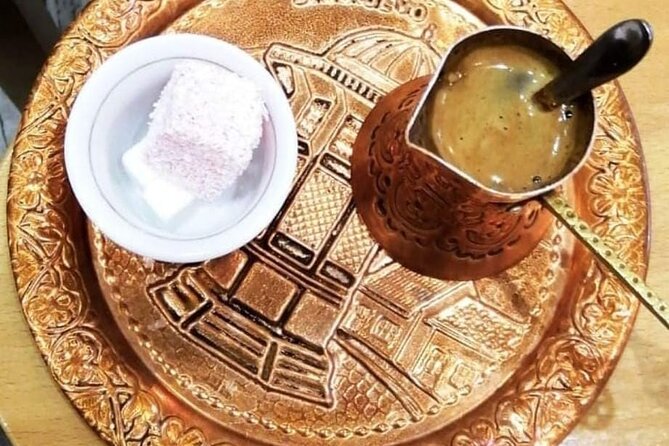
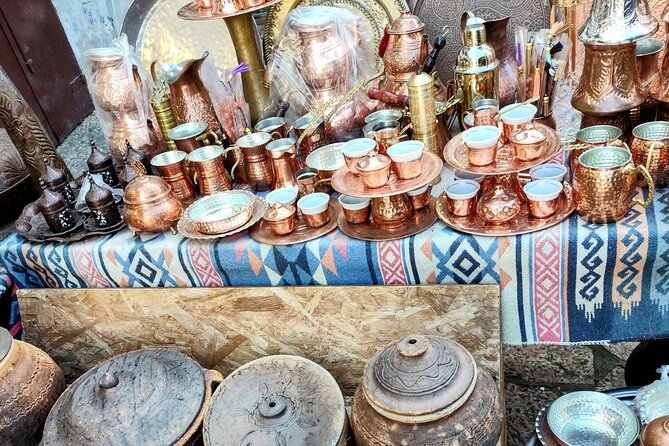
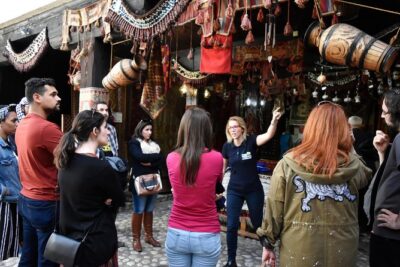
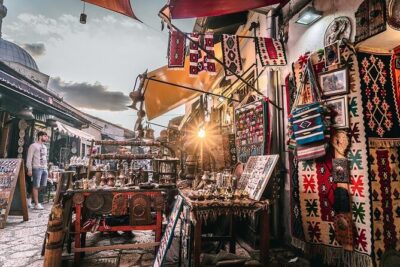
Then you step into Coppersmith Store Hidic, tied to Sarajevo’s famous coppersmithing tradition. The tour description points to “a few dozen” copper items, including traditional coffee sets and souvenirs, with handicraft traditions that have been active here for nearly 500 years.
This stop is more than shopping, even if you do want to buy something. When a place has that kind of continuous craft history, the items feel less like mass production and more like cultural continuity. It also helps you understand why Sarajevo has a strong visual identity beyond just buildings. Your eyes start noticing small patterns, workshop signage, and the way everyday objects carry heritage.
Practical consideration: this is a quick visit too, about 5 minutes. If you are serious about choosing a piece, go in with a basic plan. Pick what you want to see first, like coffee sets if that is your interest, and ask about materials or typical uses only if you have time.
Emperor’s Mosque from 1457, plus two mosques in one route
After the craft stop, you move to Emperor’s Mosque, noted as the oldest mosque in Sarajevo, dated 1457. That age gives you instant context. In one short walking sequence, you go from a story about electricity in 1898 to a mosque that dates back to the mid-1400s.
That is a good pattern for a first visit. Sarajevo can feel complicated at first. Short “time jumps” like this help your brain organize the city’s timeline without you needing a textbook.
Keep your expectations practical: the visit here is brief, around 5 minutes, and the focus is mainly on orientation and key facts. Also, religious sites can mean different rules for visitors depending on the time of day and local practice. Dress modestly and be ready to follow guidance from your guide on the spot.
Sebilj Fountain and Sarajevo City Hall, plus the moved-house story
Next up is Sebilj Brunnen (Fountain), described as Sarajevo’s most famous public fountain. This is one of those places where you look for motion and social life. Even on a short stop, you can feel why it became a meeting point, a photo target, and a landmark that sticks in people’s memories.
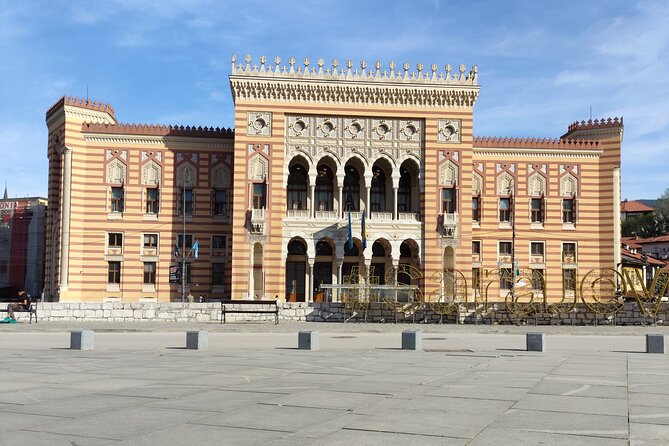
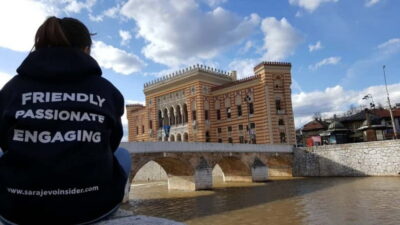
Then the tour heads to Sarajevo City Hall, a city symbol. Here you get a story you can actually remember: the tale of a stubborn Bosnian whose house was moved to the other side of the river because of the construction of this beautiful town hall.
Two details make this stop useful. First, city halls are not only administrative buildings, they are a statement about order and authority. Second, the moved-house story makes you think about the cost of big projects for regular people. It turns a monument into a human-scale lesson.
Important for your wallet: admission to Sarajevo City Hall is not included. So if you want to go in, you should budget an extra amount on the day. If you do not, you can still get the outside context, since the tour time here is short.
Morica Han, then the Old Sarajevo Clock Tower with lunar time
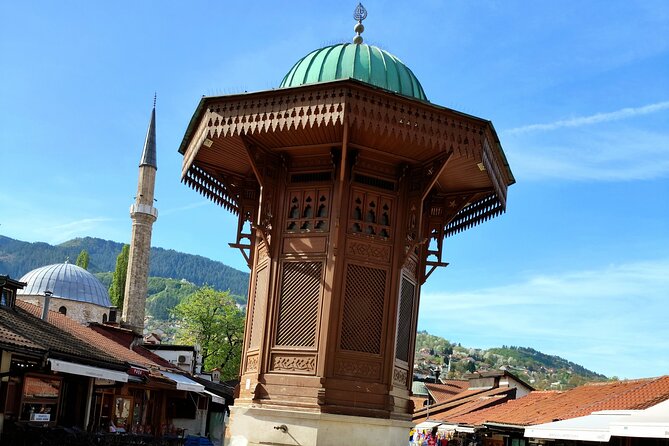
Now you step into Ottoman-era travel culture at Morica Han. The description is clear: it was an inn where merchant caravans could find accommodation during the Ottoman period. In other words, this is not just a pretty historic building. It is part of how trade worked, how people traveled, and how Sarajevo became a stop in larger routes.
Your next stop is Old Sarajevo Clock Tower, about 30 meters high, and the truly standout weird fact: its clock is the only public clock in the world that keeps lunar time. That makes this stop feel like a storybook detail, but it is presented as a real, trackable trait of the clock.
Why you will care: lunar time is not something your everyday life prepares you for. Seeing it in a public tower makes you realize how societies measured life differently. It also gives you a “how did they think?” moment, which is often what tours are really trying to give you.
Practical tip: keep your phone ready but also pause and look. This is a quick visit (about 2 minutes listed for the tower moment). If you wait until the last second to take photos, you will miss the guide’s explanation.
Tašlihan caravanserai, then Latin Bridge and the WWI trigger
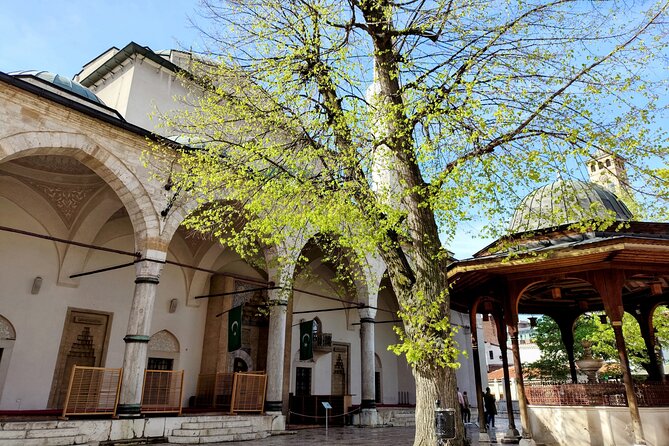
After the clock, the tour goes to Tašlihan, an old Ottoman caravanserai. The description notes that caravans would stop here for food and shelter. Again, you are seeing architecture tied to movement and survival, not just aesthetics.
Then the walk takes a darker turn to Latin Bridge, the place where the spark that led to the beginning of World War I was ignited. This is the kind of stop where you will feel the weight of history more than you see it. Sarajevo’s Ottoman-era stops and this moment connect through one lesson: cities at crossroads do not stay untouched by world events.
This is also why a guided route helps. Even if you know the broad WWI storyline, your guide can place the location in local context, giving meaning to a famous spot that can otherwise feel abstract.
For pacing, this segment includes about 7 minutes at Latin Bridge. So listen closely early, then take photos only after you understand what you are looking at.
The Museum of the Jews, and why oldest synagogue matters
Next you visit the Museum of the Jews of Bosnia and Herzegovina, described as the oldest synagogue in Bosnia and Herzegovina. This stop is short, about 5 minutes, and it may not feel like the biggest stop on paper. But the “oldest” label changes the purpose of your visit.
It is a reminder that Sarajevo’s story is not only about empires and wars. It is about communities that lived there, built institutions, and left landmarks that still exist. When you add this stop to the route, the city’s “meeting of cultures” theme stops being a generic phrase and becomes visible in the built environment.
Practical consideration: if you want more detail here than a short stop allows, you can use the tour as a starting point and then return on your own with more time.
Vječna vatra Eternal Flame, the WWII liberation memorial
You started (or rather, you gathered) at Vječna vatra, the Eternal Flame memorial. The tour description frames it as a memorial to those who liberated Sarajevo during World War II. The stop time is about 5 minutes.
What I like about ending here is emotional clarity. After the route covers trade stops, architecture, and a WWI trigger, the memorial gives a later, local human scale to all that big-event history. It tells you that Sarajevo’s modern identity was shaped by sacrifice and liberation too.
This is a good place to take stock. Stand still for a moment, then let the tour’s earlier stories settle. That is when the city starts to feel coherent.
Price, tickets, and what to budget beyond $12.10
At $12.10 per person, this walking tour is priced for maximum value. Here is what you typically get for that amount: a tour guide (included) and a route that hits major sights without piling on paid admissions at each turn.
Most stops list free admission tickets, which is a big deal for value. The one clear exception in the provided info is Sarajevo City Hall, where admission is listed as not included. So you should expect a small extra cost if you want to go inside.
Tips are not included, so if this guide earns your gratitude, plan to add a tip. Also, confirmation is sent within 48 hours of booking, subject to availability, so you want to book with enough lead time.
Finally, the tour is offered in English, and it is near public transportation. That means you are not forced into a difficult arrival plan on day one.
One more practical note: your physical fitness level should be moderate. This is walking, with time spent standing at various points. If you prefer slow travel and long breaks, plan to do fewer other activities the same day.
Who should book, and who might want a slower option
Book this tour if you want:
- A first-time Sarajevo orientation with a guide who connects the dots
- Quick access to key landmarks like Gazi Husrev-beys Mosque, Sebilj Fountain, Latin Bridge, and Vječna vatra
- A strong mix of themes, from Ottoman caravan culture to World War I and WWII
You might want a slower self-paced plan instead if:
- You dislike tight stop times, since many moments are only 5 minutes
- You want deep museum time, because this route is about highlighting, not extended stays
One especially nice detail: the guide quality matters here, and one name that comes up is Aid Celjo, noted as an excellent guide who took people to the best spots and gave a strong lesson in Sarajevo’s history. That kind of history teaching is exactly what makes a short route feel worth it.
Should you book this Sarajevo Walking Tour?
If you are short on time and you want Sarajevo’s highlights with clear context, I think this is a smart buy. The price is low for a guided route, many entries are free, and the itinerary covers both beautiful architecture and world-shaping events.
If you are the type who needs long viewing pauses and deep reading at every stop, the pacing may feel too quick. But if you can handle a brisk walk, you will come away with a city you understand better, not just a list of places you visited.
FAQ
How much does the Sarajevo Walking Tour cost?
The tour costs $12.10 per person.
How long is the tour?
The duration is about 2 hours.
Is the tour offered in English?
Yes, it is offered in English.
Do I get a mobile ticket?
Yes, the tour includes a mobile ticket.
Are any admission tickets included?
Many stops list admission tickets as free, but Sarajevo City Hall admission is not included.
Where does the tour start and end?
It starts and ends at Vječna vatra in Sarajevo, at the Ferhadija area (as listed in the meeting point).
What is the maximum group size?
The tour has a maximum of 30 travelers.
Can I cancel for a full refund?
Yes. Free cancellation is available, and you can cancel up to 24 hours in advance for a full refund.
Most recently added near Sarajevo
- Sarajevo : Private Walking Tour With A Guide (Private Tour)★ 5.0 · 1 review
- Sarajevo: Islamic Tour | 500+ years of Glorious Heritage★ 5.0 · 1 review
- Sarajevo: Srebrenica – A Journey of Remembrance★ 5.0 · 1 review
- Transfer tour Sarajevo-Dubrovnik★ 5.0 · 1 review
- Bunker: Tito’s Secret & Boracko Lake Tour from Sarajevo★ 5.0 · 1 review
- Svrzo House Entrance Ticket★ 5.0 · 1 review
- Thrilling Rafting Adventure on the Neretva River with Lunch★ 5.0 · 1 review
- Private transfer (FROM-TO) Sarajevo – Dubrovnik★ 5.0 · 1 review
Walking Tours, compared.
Private Walking Tour, Food Tasting and Bosnian Coffee in Sarajevo
Read our review →
Browse the lists this tour appears in