
Reviewed · WALKING TOURS
Crossroads of Cultures – Sarajevo Walking Tour
Sarajevo is a story you can walk. This 2-hour, small-group route gives you a clear sense of why the city feels like a crossroads of cultures, moving from sacred sites to daily street life without dragging. I especially like the local-guide energy, and guides such as Adnan are repeatedly described as helpful, friendly, and genuinely into explaining the city.
I also like that the tour blends “big landmarks” with hands-on street stops. You get to hear context at places like Kazandziluk, where the focus includes how Bosnian coffee is made, and you’ll also get guide recommendations for eating well, including cevapcici and burek.
One thing to consider: the walk is short, and not every indoor stop is covered. Museum and cathedral entries like the Jewish Museum of Bosnia and Herzegovina, Sarajevo City Hall, and the Serbian Orthodox Cathedral are listed as not included, so you might pay extra if you want to go in everywhere.
In This Review
- Key highlights you should know before you go
- Why this 2-hour Sarajevo walk is such good value
- Meeting point and timing, with less hassle than you think
- Stop by stop: how the route tells Sarajevo’s story
- 1) Toureedoo office to Sacred Hearth Cathedral (Katedrala Srca Isusova)
- 2) Jewish Museum of Bosnia and Herzegovina: the first Jewish temple in Sarajevo
- 3) Sarajevo Meeting of Culture: east meets west in street-level form
- 4) Gazi Husrev-beg Mosque and the old Sarajevo clock tower
- 5) Morica Han: the only preserved han, like a motel from old Sarajevo
- 6) Sebilj Brunnen (Fountain): the iconic pigeons’ square
- 7) Kazandziluk: old crafts and making Bosnian coffee
- 8) Bravadziluk Street: where you get cevapcici and burek ideas
- 9) Sarajevo City Hall: Austro-Hungarian beauty, and an optional entry cost
- 10) Latin Bridge: the event that shook the world in 1914
- 11) Serbian Orthodox Cathedral: another faith center, and another optional entry
- 12) Pijaca Markale: market life for fruits, vegetables, and meat
- 13) Eternal Flame: WWII memory in the final minutes
- Price and what is included for $24.08
- The guide factor: what Adnan-style hosting does for your experience
- Who should book this walking tour, and who might want more time
- Should you book the Crossroads of Cultures Sarajevo Walking Tour?
- FAQ
- How long is the Crossroads of Cultures Sarajevo Walking Tour?
- What time does the tour start?
- Where does the tour meet and start?
- Is the tour offered in English?
- What is included in the price?
- Are museum tickets included?
- Is lunch included?
- What is the group size limit?
- What happens if the weather is bad?
Key highlights you should know before you go
- A 2-hour route that gets your bearings fast across the city’s most recognizable culture markers
- Stops for multiple faiths and communities, including the Sacred Hearth Cathedral, Gazi Husrev-beg Mosque, and the Jewish Museum area
- A real street-food angle, with guide recommendations for cevapcici and burek when you pass Bravadziluk Street
- Bosnian coffee is part of the experience, with Kazandziluk included as a craft and coffee-focused stop
- A small group limit (max 15) helps keep questions easy and the walk from feeling rushed
A few more Walking Tours in Sarajevo
- Sarajevo: Grand Walking Tour Through Time and Cultures
★ 4.8 · 1,236 reviews - Sarajevo: 2 Hours Old Town Walking Tour With Local Guide
★ 5.0 · 505 reviews - Private Walking Tour, Food Tasting and Bosnian Coffee in Sarajevo
★ 5.0 · 255 reviews - Sarajevo Grand Walking Tour
★ 5.0 · 232 reviews
Why this 2-hour Sarajevo walk is such good value
Sarajevo can feel layered, and that is exactly why this tour format works. In about two hours, you cover the kind of places you usually only hit across multiple days: religious landmarks, old-town structures, a major bridge tied to the 1914 Sarajevo assassination, and a few stops that bring you into the city’s everyday rhythm.
Value-wise, the price is $24.08 per person, and the guide time is included. Even better, a lot of the route is either free entry or has admission included, so you are not paying tour money plus a long list of separate tickets just to see the basics. You also return back to the start point at the end, which helps keep your planning simple.
The best part for first-timers is that you are not just looking at buildings. You are getting the “why” behind the city’s layout, its meeting of cultures, and how different communities shaped what Sarajevo looks and feels like today.
Meeting point and timing, with less hassle than you think
The tour starts at Muvekita 7, Sarajevo, with a start time of 10:30 am. It ends back at the meeting point, so you do not need to map your way across town when you finish.
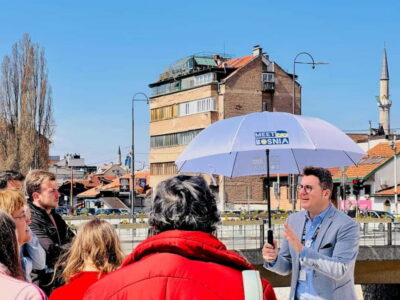
It runs with a maximum of 15 travelers, which is a sweet spot for a walking tour: large enough to feel social, small enough that your guide can keep track of the group. It is offered in English, and you get a mobile ticket, which makes check-in straightforward.
One practical tip: since this is an outdoor walk, wear shoes that handle uneven old-street sidewalks. The route is short, but Sarajevo neighborhoods can involve frequent turns and stops.
Stop by stop: how the route tells Sarajevo’s story
Another way to spend the day from here:
- Fall of Yugoslavia, Sarajevo War Tour with Tunnel of Hope Museum and Frontlines
★ 5.0 · 1,314 reviews


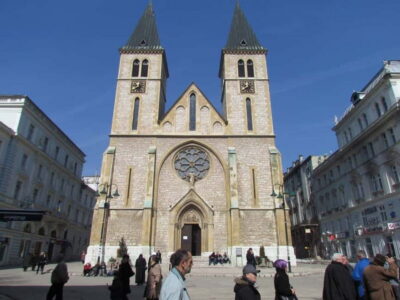
1) Toureedoo office to Sacred Hearth Cathedral (Katedrala Srca Isusova)
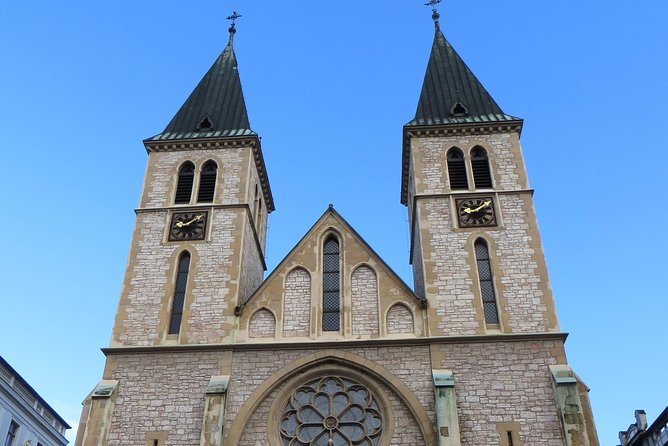
You begin in front of the Toureedoo – Sarajevo City Tours office, then head straight into one of Sarajevo’s most recognizable religious landmarks: the Sacred Hearth Cathedral (Katedrala Srca Isusova). The tour includes time here with a guide who shares important information about the site, and admission is listed as included for this stop.
What you can expect: the guide sets the tone early. Instead of treating the cathedral as just a photo stop, you learn how it fits into Sarajevo’s identity. It is a smart move because it gives context before you start moving through other faiths and cultures.
If you love architecture, you will probably enjoy this part. If you prefer history and meaning over details, it still works because the guide’s job here is to explain why people care about the place.
2) Jewish Museum of Bosnia and Herzegovina: the first Jewish temple in Sarajevo
Next comes the Jewish Museum of Bosnia and Herzegovina. This is described as the place where the first Jewish temple was built in Sarajevo. Admission for this stop is listed as not included, so plan for an extra ticket if you want to go in.
Why this matters on a walking tour: it is easy to think of Sarajevo’s multicultural story as a general theme. This stop makes it concrete by connecting the city to a specific community and a specific landmark associated with Jewish life.
You should also know the timing here is short. Expect an overview and a set of highlights, not a deep museum day. If you want to linger, you may need to budget extra time on your own later.
3) Sarajevo Meeting of Culture: east meets west in street-level form
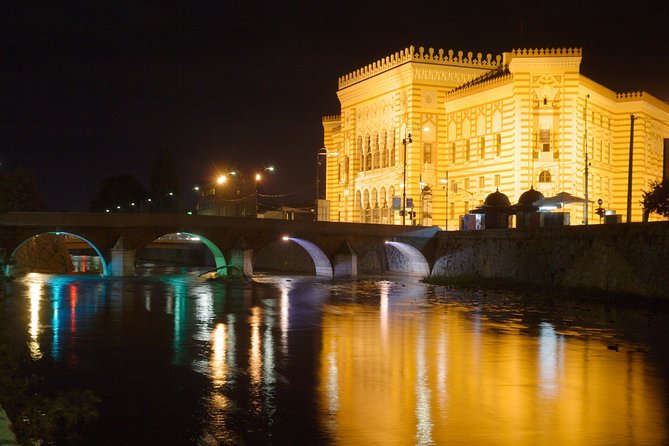
Then you reach a stop built around a simple idea: Sarajevo is a place where east meets west, explained by the guide at the Sarajevo Meeting of Culture area. Admission is listed as included for this stop.
This is one of those stops that works even if you do not know Sarajevo well yet. The guide ties the city’s layout and landmarks into an actual explanation, so the cross-cultural “theme” stops being abstract. You see how different influences sit side by side in the same city.
If you enjoy learning patterns, not just facts, this section tends to land well.
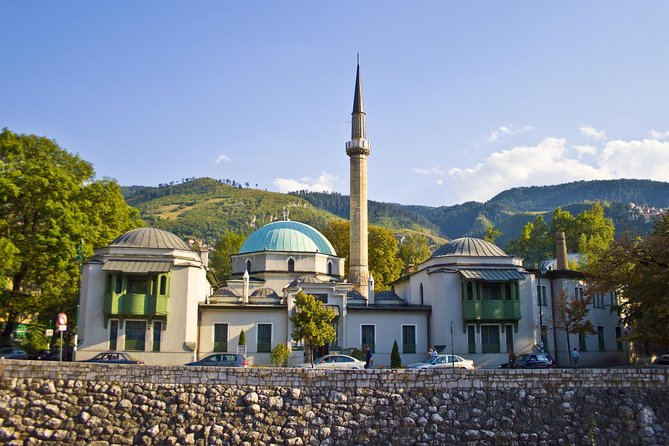
4) Gazi Husrev-beg Mosque and the old Sarajevo clock tower
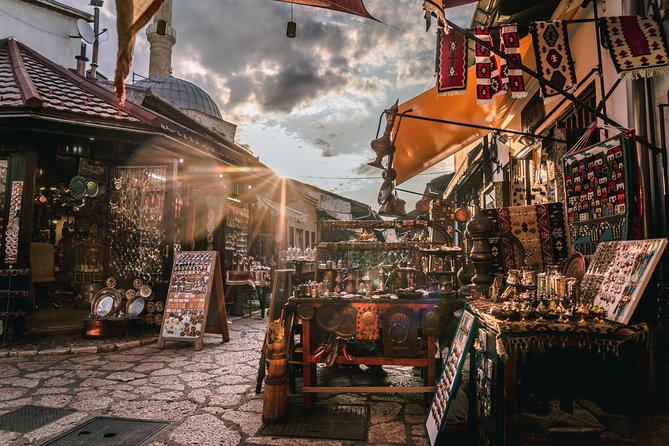
After that, you shift into Ottoman-era spiritual history at the Gazi Husrev-beg Mosque. Admission is listed as free for this stop. The guide also uses this stop to explain more about the mosque and its role as a central one in Bosnia and Herzegovina.
From there, you move to the Old Sarajevo Clock Tower, with a short guide explanation of why it matters. Admission is listed as free for this too.
What to look for: the contrast between these stops is the point. You are not meant to see every building the same way. One moment you are in a religious center linked to Bosnian Islamic culture, and the next you are absorbing a historic city marker that helps define old-town character.
This pairing also helps you pace the tour. After indoor or semi-indoor religious content, the clock tower stop feels like a breather where you can take in the surrounding streets.
5) Morica Han: the only preserved han, like a motel from old Sarajevo
Next comes Morica Han, described as the only preserved han, or motel, in Sarajevo. Admission is listed as included for this stop, and the guide spends time here explaining what you are looking at.
This is a fun stop because it takes you out of “religion landmark mode” and into the city’s practical history: how people moved, stayed, and traded in old Sarajevo. Even in a short walking tour, this kind of stop adds texture.
If you like everyday history, you will likely enjoy this more than you expect.
6) Sebilj Brunnen (Fountain): the iconic pigeons’ square
Then you hit Sebilj Brunnen, the fountain also known as Pigeons Square. Admission is listed as included.
Expect this to be lively. It is the kind of iconic place that helps you understand Sarajevo as a living city, not just a sequence of monuments. The guide’s job here is to place it in the larger story, so you get more than a quick snapshot.
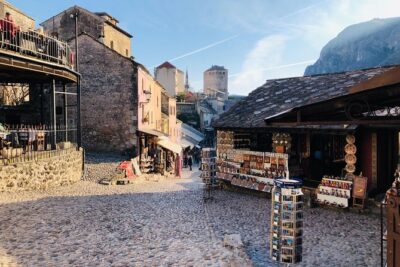
7) Kazandziluk: old crafts and making Bosnian coffee
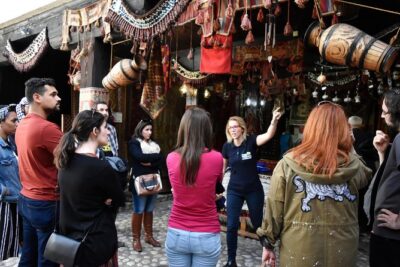
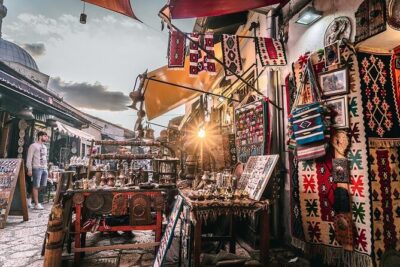
Now you get into the street-level culture stops at Kazandziluk, focused on old crafts and the way to make Bosnian coffee. Admission is listed as free for this stop.
This is one of the most memorable parts for many people because it is not abstract. It’s a sensory kind of learning: the guide explains a traditional craft practice, with coffee-making as the centerpiece. And given how often guides like Adnan are praised for friendly, upbeat explanations, this is a great time to ask questions.
If you are the type who thinks, I want to take something home from this city beyond photos, you will probably appreciate this stop.
8) Bravadziluk Street: where you get cevapcici and burek ideas
Next is Bravadziluk Street, where the guide recommends the best places to taste cevapcici & burek. Admission is listed as free for this stop.
This is not a formal food tour, but it is a smart add-on. You are already walking through old Sarajevo, and your guide points you toward what to eat nearby, so you can turn the tour into a real meal plan without guessing.
Practical note: come hungry, but also know you may only get recommendations, not a full tasting included.
9) Sarajevo City Hall: Austro-Hungarian beauty, and an optional entry cost
Then you pass Sarajevo City Hall, described as one of the most beautiful buildings from the Austro-Hungarian period. Admission is listed as not included, meaning you might pay separately if you want to go in.
Even if you skip an interior visit, this stop matters because it adds another layer to Sarajevo’s “crossroads” identity. The guide helps you connect political and architectural influences to the city you see today.
If you are short on budget, you can still get value by focusing on what is outside and asking what is worth seeing inside.
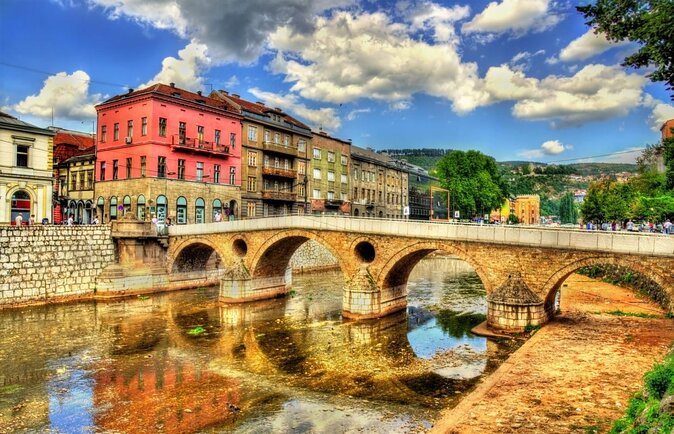
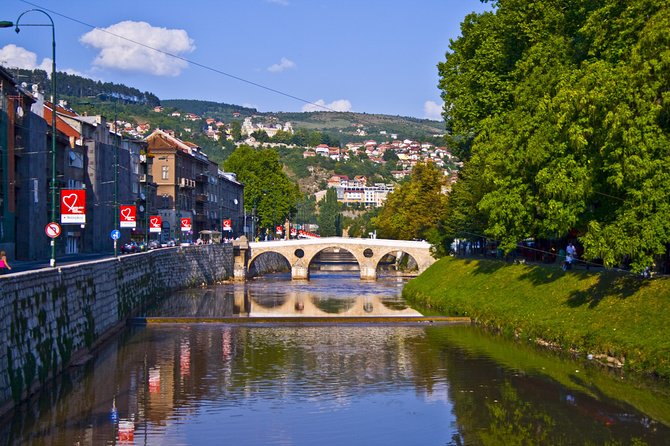
10) Latin Bridge: the event that shook the world in 1914
You then reach Latin Bridge, with the guide explaining the event that shook the world: the Sarajevo assassination 1914. Admission is listed as free for this stop, and the time here is longer than some stops, at around 20 minutes.
This is the emotional anchor of the walk. It gives Sarajevo’s global historical importance a concrete place. Even if you have only a basic sense of the story, this is where the guide can clarify what you are actually standing near and why it matters.
Expect a careful, story-driven explanation here. It is a good moment to slow down and actually look around.
11) Serbian Orthodox Cathedral: another faith center, and another optional entry
After Latin Bridge, the tour includes the Serbian Orthodox Cathedral. The guide shares the story about the main Orthodox church in Sarajevo, but admission is listed as not included.
This stop rounds out the multi-faith pacing of the route. You see how Sarajevo’s identity is tied to multiple religious communities, each leaving its own mark.
If you choose to pay for this one, it is a good way to turn the tour’s “overview” into a more complete experience. If you decide not to, you can still absorb the guide’s explanation outside and keep your schedule tight.
12) Pijaca Markale: market life for fruits, vegetables, and meat
Next comes Pijaca Markale, the city market. The guide points out that it is a popular place to buy fruits, vegetables and meat products. Admission is listed as free for this stop.
This is the best kind of contrast after heavy history: you get back to daily life. Markets are where a city’s culture becomes practical and immediate, and your guide’s presence helps you connect it to the broader old-town setting you have been walking through.
Even if you do not shop, it helps to watch how the space is used.
13) Eternal Flame: WWII memory in the final minutes
Finally, you end with Eternal Flame, a monument dedicated to WWII fighters. Admission is listed as free, with about 5 minutes of guide time.
This ending works because it is both simple and powerful. Even without any extra admission, it gives you a moment of reflection to close the loop on the city’s layers of history.
Then you finish back at the meeting point, Muvekita 7.
Price and what is included for $24.08
At $24.08 per person, you are paying for a guided walking route plus access to several included or free stops. The tour explicitly includes the tour guide. Many sights are marked as admission free or included, while a handful of indoor sites are not included.
From your perspective, the key question is how you like to travel:
- If you enjoy guided context and are fine with short stops, you can get a lot out of this price.
- If you plan to enter every single not-included site, your total trip cost will rise, because museums and certain buildings are extra.
Also, lunch is not included. The tour gives you food guidance at Bravadziluk Street, but it does not hand you a meal. Plan to eat after the tour using your guide’s suggestions, or bring your own snack if your day runs long.
The guide factor: what Adnan-style hosting does for your experience
A huge part of why this kind of tour works is the guide. Names like Adnan show up in feedback for being helpful, smiling, and consistently enthusiastic about Sarajevo. That matters because you are walking through complex cultural ground in a short window.
When the guide keeps things friendly and clear, you learn faster. You also feel more comfortable asking follow-up questions, like what each place means or which stop is “worth it” if the group time is limited.
If you want the most from this experience, go in with one or two questions ready. For example: which stop best shows the city’s east meets west theme? Or which place is your must-remember landmark for first-time Sarajevo visitors?
Who should book this walking tour, and who might want more time
This is a great fit if you:
- want a 2-hour orientation to Sarajevo
- enjoy a route that connects faith, craft, food, and major historical sites
- prefer guided explanations over solo wandering
- like small group experiences, with a maximum of 15 people
It may not be perfect if you:
- want long museum time, because the stop durations are short
- hate paying extra for indoor entrances when some stops are marked not included
Should you book the Crossroads of Cultures Sarajevo Walking Tour?
I think you should book it if you want a smart first pass through Sarajevo without overplanning. The mix of landmarks plus street culture, along with guide help and a manageable 2-hour pace, makes it a strong deal at $24.08.
I would also book it if you are traveling in English and want the route explained clearly, with names like Adnan standing out for friendly, upbeat guidance.
Skip or consider a different option if you already know Sarajevo well and only want deep museum time, or if you strongly prefer experiences where every single entrance is included. In this tour, a few indoor stops are extra, and the walk is designed to keep moving.
FAQ
How long is the Crossroads of Cultures Sarajevo Walking Tour?
It lasts about 2 hours.
What time does the tour start?
The tour starts at 10:30 am.
Where does the tour meet and start?
It starts at Muvekita 7, Sarajevo 71000, Bosnia and Herzegovina.
Is the tour offered in English?
Yes, it is offered in English.
What is included in the price?
The tour guide is included. Some admissions are listed as included or free, but not all entrances are included.
Are museum tickets included?
Not always. Entrance fees to museums are listed as not included, and stops like the Jewish Museum of Bosnia and Herzegovina are marked as admission not included.
Is lunch included?
No, lunch is not included.
What is the group size limit?
The tour has a maximum of 15 travelers.
What happens if the weather is bad?
This experience requires good weather. If it is canceled due to poor weather, you will be offered a different date or a full refund.
Most recently added near Sarajevo
- Sarajevo : Private Walking Tour With A Guide (Private Tour)★ 5.0 · 1 review
- Sarajevo: Islamic Tour | 500+ years of Glorious Heritage★ 5.0 · 1 review
- Sarajevo: Srebrenica – A Journey of Remembrance★ 5.0 · 1 review
- Transfer tour Sarajevo-Dubrovnik★ 5.0 · 1 review
- Bunker: Tito’s Secret & Boracko Lake Tour from Sarajevo★ 5.0 · 1 review
- Svrzo House Entrance Ticket★ 5.0 · 1 review
- Thrilling Rafting Adventure on the Neretva River with Lunch★ 5.0 · 1 review
- Private transfer (FROM-TO) Sarajevo – Dubrovnik★ 5.0 · 1 review
Walking Tours, compared.
Private Walking Tour, Food Tasting and Bosnian Coffee in Sarajevo
Read our review →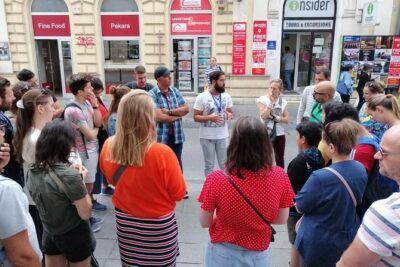
Browse the lists this tour appears in