
Reviewed · WALKING TOURS
Mostar Tales: A Journey Through Centuries Walking Tour
Stari Most makes Mostar snap into focus. In about 1 hour 20 minutes, I like how this walk connects the Franciscan Church tower to the Old Bridge area, so you grasp the city’s core fast. The route is designed for seeing the important landmarks without turning your day into a marathon.
My favorite part is the guide, who explains the story behind the bridge divers while you’re actually standing in the right place. You also get to add the Crooked Bridge stop, which gives Mostar a more layered feel. One consideration, some entrances are optional, so you may spend a little extra if you choose to go inside at certain stops.
In This Review
- Key highlights to look for
- How this 1 hour 20 minute private walk helps you read Mostar
- Starting at the Franciscan Church and Monastery of St. Peter and St. Paul
- Stari Most and the bridge divers story you can walk under
- The Ottoman-era pause: Crooked Bridge (Kriva Cuprija)
- Hadži-Kurt Mosque (Tabacica) with entry included
- Kujundžiluk Street and the old bazaar pass-by
- Ending at Koski-Mehmed Pasha Mosque
- Price and value: what you’re really paying for at $24.02
- Practical tips so you enjoy every step
- Should you book Mostar Tales with Meridian Travel?
- FAQ
- How long is the Mostar Tales walking tour?
- Where does the tour start and end?
- What is included in the price?
- Are entrance tickets included?
- What time does the tour begin?
- Can I cancel and get a full refund?
Key highlights to look for
- Old Bridge area storytelling that covers Stari Most’s background and the daredevil bridge divers
- Crooked Bridge (Kriva Cuprija), built in 1558, a rare early detour before you reach the famous span
- Hadži-Kurt Mosque access included with Ottoman-style design elements like the central dome and minaret
- Kujundžiluk Street bazaar atmosphere on foot, where the Ottoman-era marketplace idea still shapes the street
- End at Koski-Mehmed Pasha Mosque with Ottoman heritage front and center
A few more Walking Tours in Mostar
- Mostar Private Walking Tour
★ 5.0 · 93 reviews - Walking tour in Old Town Mostar
★ 4.4 · 35 reviews - Charming Mostar: Private Mostar Walking Tour
★ 5.0 · 23 reviews - Best of Mostar – Private Walking Tour
★ 5.0 · 21 reviews
How this 1 hour 20 minute private walk helps you read Mostar
Mostar has a way of pulling you in, but it can also confuse you at first. This tour helps because it’s short, focused, and designed as a line you can follow. You start at the Franciscan Church area and work your way down toward the Ottoman heart of the city.
Another thing I like is that it’s a private tour, meaning it’s only your group. That matters because questions do not get lost in a crowd, and the guide can adjust the pace if you want more photo time near the water. The experience runs about 1 hour 20 minutes and starts at 10:00 am, which is a nice anchor if you want the rest of the day for your own wandering.
You’ll also get a mobile ticket, so you’re not fumbling with printouts while you’re trying to find the meeting point. And because it’s a walking tour, it naturally fits Mostar’s tight Old Town layout.
Starting at the Franciscan Church and Monastery of St. Peter and St. Paul
Your tour begins at Franjevačka Crkva u Mostaru (Franciscan Church and Monastery of St. Peter and St. Paul). You gather near the tower area, and your authorized guide meets you there with an overview of what you’ll see and why each spot matters. It’s a good first step because it sets the city’s religious and cultural mix in your mind before you ever reach the river views.
One practical detail: admission is not included at this first stop. That doesn’t mean you’re out of luck. It means you can still appreciate the area from outside and decide on your own whether you want to pay to go in, based on time and interest.
Even if you only spend a short moment here, I think it helps you understand the scale of what you’re about to walk through. Mostar is often discussed through Ottoman landmarks, but starting with the Franciscan presence reminds you this place has layered identities in close range.
Stari Most and the bridge divers story you can walk under
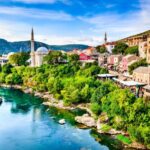
The tour then shifts you into the Old Bridge area, centered on Stari Most, the 16th-century Ottoman bridge. This bridge was constructed between 1557 and 1566, commissioned during the Ottoman period under Sultan Suleiman the Magnificent. The guide also connects the bridge to the daring bridge divers, so the crossing is not just architecture, it is also local tradition and spectacle.
This is the stop where your photos will multiply, but it’s also where you’ll likely slow down to actually take it in. Standing around the Old Bridge zone, you can feel why this spot remains the symbol of Mostar. You get the river setting, the built forms clustered around it, and the sense of viewing history from street level.
Also, the Old Bridge area is described as UNESCO-listed, which is a helpful clue that you are seeing a protected historic core. In practice, that means your guide’s explanations will usually focus on why the bridge matters beyond aesthetics, including how it shaped movement and identity in the centuries after it was built.
Here’s the tradeoff: admission is not included for the Old Bridge stop. Depending on what you choose to do on-site, you may need to add optional tickets. If your priority is learning the story and getting the views, you can still have a satisfying experience without paying extra.
Another way to spend the day from here:
The Ottoman-era pause: Crooked Bridge (Kriva Cuprija)
Right after the Old Bridge zone, you’ll head to Crooked Bridge (Kriva Cuprija). This bridge was built in 1558, just a few years before Stari Most was completed in 1566. That timing is the point, it puts you into an earlier phase of Mostar’s bridge-building story.
I like this stop because it breaks the pattern. Mostar visitors tend to focus on the famous span, and Crooked Bridge gives you contrast. You still get the river crossing idea, but you also get a different shape, a different vibe, and a reminder that the city’s infrastructure has older roots than the big postcard moment.
Admission is not included here as well, so you’ll mainly be seeing it from the outside as part of the walk. The practical benefit is that it doesn’t chew up your time. You get a meaningful history marker without turning the day into multiple ticket lines.
If you enjoy little structural stories, this is where the tour starts feeling more personal. The guide’s explanation helps you recognize that the city’s landmarks didn’t appear all at once. They came in stages, and that makes Mostar feel more believable.
Hadži-Kurt Mosque (Tabacica) with entry included
Next up is Hadži-Kurt Mosque (Tabacica), an Ottoman-style mosque with a central dome and a minaret. Here’s a real value point: admission is listed as included at this stop. So unlike some other parts of the route where you may decide whether to pay, this one is already accounted for.
Ottoman mosque design can look similar at a distance, but up close you start noticing the elements your guide is pointing out, especially the layout and the way the dome shapes the interior space. Even if you keep your visit brief, having a guide explain what you’re looking at turns a quick glance into something more useful.
This is also a quieter moment in the walk. The energy tends to shift from the Old Bridge spectacle to a place that feels more grounded and local. If you’re traveling through Mostar and you want balance, this is a great middle stop.
Kujundžiluk Street and the old bazaar pass-by
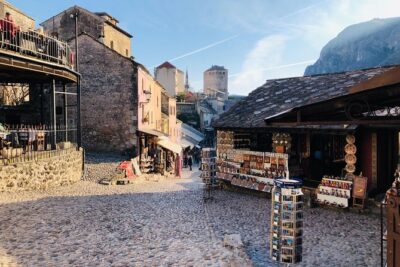
After the mosque, the tour passes by Bazar Kujundziluk and the surrounding Kujundžiluk Street area. This is the Ottoman-period marketplace zone, historically a place where traders, craftsmen, and shoppers all overlapped in one compact space.
In practical terms, this means you’ll see the kind of street that still supports everyday browsing and grabbing a coffee. The tour keeps it as a pass-by area, so you won’t be stuck for long in shopping mode unless you choose to linger on your own.
Why I think this works on a time-limited tour: it gives you the social fabric of Mostar, not just the architecture. Bridges and mosques are huge, but markets are where daily life echoes through time. Even a short stop helps you understand why visitors talk about this area as more than a monument.
Admission is listed as free in the itinerary for this pass-by stretch, so you can enjoy it without extra costs.
Ending at Koski-Mehmed Pasha Mosque
The tour finishes at Koski Mehmed Pasha Mosque at Mala Tepa 16. You get there after passing by the mosque area, and the tour is designed to end at this key Ottoman landmark. The mosque is described as a strong example of Ottoman architecture, with a distinctive dome, a minaret, and a spacious courtyard.
I like ending here because the tour’s themes come together. You’ve already visited or discussed Christian and Ottoman landmarks, and now you’re closing with one of the most direct reminders of how the Ottoman era shaped Mostar’s built environment. The guide also frames the mosque as more than a worship site, it’s a cultural and historical symbol, tied to Mostar’s multicultural past.
If you’re the type who enjoys finishing a walk with a place you can sit with for a moment, this ending point helps. You also get a clear sense of where your walking day stops, which is useful if you plan to meet friends later or catch onward plans.
Price and value: what you’re really paying for at $24.02
At $24.02 per person, this tour is priced like a budget-friendly way to get guided context. The key value isn’t just the landmarks. It’s having an authorized guide stitch them together into a coherent story in about 1 hour 20 minutes.
This price includes a professional authorized guide, and that’s often the difference between seeing photos and understanding what you’re seeing. The guide also answers questions, and the single standout review highlights exactly that kind of helpful, informative conversation.
There is also a smart tradeoff built into the structure. Some stops have admission optional, and one mosque is included. That means you’re not locked into paying for every entrance. You can spend extra only where you personally want it.
Finally, private tour structure matters for value. You’re paying for a guided experience, but not in a crowded format where questions get skimmed over.
Practical tips so you enjoy every step
This is a walking tour in Mostar’s central areas. You’ll want comfortable shoes because you’ll be on old-town streets and near historic river zones. If you’re someone who hates slowing down for stairs or uneven pavement, it’s worth planning footwear accordingly.
Weather matters. The experience is listed as requiring good weather, and if it gets canceled due to poor weather, you’ll be offered a different date or a full refund. That’s not just fine print. It’s a real signal that the route makes the most sense when you can move outdoors comfortably.
Start at 10:00 am if you can. Morning timing generally helps with light for photos and gives you energy for the rest of your day afterward. You also get a clear meeting point at Franjevačka Crkva u Mostaru, so you’re not guessing where the guide begins.
If you want to keep costs predictable, decide in advance which optional entrances you care about. The tour notes tickets for a Turkish house, a museum, and mosque entrances are optional. If you’d rather just focus on the street-level sights and guided explanations, you can usually keep spending under control.
Should you book Mostar Tales with Meridian Travel?
I think this is a smart choice if you want the Mostar highlights with guided context, without eating up your whole morning. The route is compact, the story focus is strong, and the guide quality seems to be the real reason people recommend it. If you enjoy architecture, bridge history, and how Ottoman landmarks shape daily spaces, you’ll likely feel satisfied even after a short walk.
Skip it or consider another format if you want a long, slow exploration or if you prefer totally self-guided sightseeing with no structured stops. Because it’s about 1 hour 20 minutes, you won’t have endless time in every spot.
Also, if you hate paying for optional entrances, you’ll want to plan your priorities. This tour includes Hadži-Kurt Mosque, but other entrances are optional. For most people, that’s manageable. For ultra-tight budgets, it’s something to watch.
Overall, this tour looks like a good “get your bearings” option for Mostar. You’ll leave with the bridge story, the Ottoman architecture context, and a clearer picture of the city’s old town layout.
FAQ
How long is the Mostar Tales walking tour?
It takes about 1 hour 20 minutes.
Where does the tour start and end?
You start at Franjevačka Crkva u Mostaru, Franjevačka 1, Mostar, and the tour ends at Koski Mehmed Pasha Mosque, Mala Tepa 16, Mostar.
What is included in the price?
The price includes a professional authorized guide. You also receive a mobile ticket.
Are entrance tickets included?
Hadži-Kurt Mosque has admission listed as included. Other entrances like the Turkish house and museum are noted as optional, so you may pay extra if you choose to go in.
What time does the tour begin?
The start time is 10:00 am.
Can I cancel and get a full refund?
Yes, you can cancel for a full refund if you cancel at least 24 hours in advance. The tour also requires good weather, and if it is canceled due to poor weather, you’ll be offered a different date or a full refund.
Most recently added near Mostar
- Going North and visit Sarajevo in a Day Tour from Mostar★ 5.0 · 1 review
- The Ottoman Experience Tour in Mostar★ 5.0 · 1 review
- Authentic Antique Museum Home★ 5.0 · 1 review
- Mostar: Private Walking Tour with Local Guide★ 4.0 · 1 review
- Top Secret Tito’s Bunker in a day tour from Mostar★ 5.0 · 1 review
- City Tour: Mostar Medival Town★ 5.0 · 1 review
- Wine Tour & Tasting (Herzegovina)★ 5.0 · 1 review
- Mostar Sunset Walking Tour with Wine Tasting★ 5.0 · 1 review
Walking Tours, compared.
Private Walking Tour, Food Tasting and Bosnian Coffee in Sarajevo
Read our review →
Browse the lists this tour appears in