
Reviewed · HISTORICAL TOURS
Mostar War Heritage Walking Tour
Mostar makes you rethink the meaning of bridges. This Mostar War Heritage Walking Tour pairs the famous Old Bridge with personal stories of the war, and it also includes a short film about the city’s past. I love that the walk connects landmarks to human lives, not just facts. The one drawback is the emotional weight, especially around the burial site and when your guide shares what they lived through.
You’ll spend about 2 to 3 hours moving through central Mostar with a professional authorized guide in English, plus time to pause at key places along the old front line. I also like the pacing, because you get viewpoints, context, and reflection instead of a rushed checklist. The tour ends back at the start point at Spanish Square, so you do not need to plan a separate meetup.
In This Review
- Key highlights to look for on this tour
- Why a war heritage walk works in Mostar, not in a museum
- Spanish Square and the Old Gymnasium, where names carry weight
- Stari Most, the chain-hung crossing, and Hajrudin’s bridge blueprint
- Mezarje Liska park, a green space that became a burial ground
- Kujundziluk bazar, copper craft roots, and why people rebuilt businesses
- Carinski Bridge and Kriva Ćuprija, the crossings most people miss
- The short film, and how it changes what you notice outside
- Price and what $47.66 really buys you
- Pacing, emotions, and the kind of guide that makes it land
- Who this Mostar War Heritage Walking Tour fits best
- Book it or skip it: my practical take
- FAQ
- How long is the Mostar War Heritage Walking Tour?
- What time does the tour start, and where is the meeting point?
- Is the tour private, and is it in English?
- What’s included in the tour?
- Is lunch included?
- What is the cancellation policy for a full refund?
Key highlights to look for on this tour
- Old Bridge stories tied to Ottoman-era design, including details like its single big stone arch and measurements
- War memory in a human scale, with personal accounts from the 1992-1995 conflict
- A short film about Mostar’s history, shown as part of the walk
- Sensitive stop at Mezarje Liska park, a burial site created because cemeteries were unavailable
- Easy-to-follow route across the river, using bridges that shaped daily movement
A few more Walking Tours in Mostar
- Mostar Private Walking Tour
★ 5.0 · 93 reviews - Walking tour in Old Town Mostar
★ 4.4 · 35 reviews - Charming Mostar: Private Mostar Walking Tour
★ 5.0 · 23 reviews - Best of Mostar – Private Walking Tour
★ 5.0 · 21 reviews
Why a war heritage walk works in Mostar, not in a museum
Mostar is one of those cities where history is not behind glass. It is outside, on streets and river crossings and in the way people rebuild. That is what makes this tour hit harder than a typical sightseeing loop. You start with architecture you recognize instantly, then you learn how the modern city sits above the scars of a brutal recent past.
I especially like the balance here. You get beauty and craft, too, not only tragedy. The walk runs through places tied to daily life, like artisan streets in Kujundziluk, then it turns to the moments that changed Mostar forever.
Just know what you are signing up for: this is not a casual “photos only” stroll. A burial ground stop and personal war stories mean you should be ready for a quieter, more thoughtful mood.
Spanish Square and the Old Gymnasium, where names carry weight
You kick things off near Spanish Square, one of the city’s main public spaces. Here, the name itself comes from the last war: it was given in 1995 to honor 21 Spanish troops killed at UNPROFOR. Even if you only spend a few minutes, that framing changes how you view what comes next.
Dominating the square is Stara Gimnazija (Old Gymnasium), completed in 1902. It is listed as a national monument, and it is built in a Moorish Revival style, sometimes called Neo-Moorish. You also learn how the building carried the name of poet Aleksa Šantić for a period.
What I like for your first moments in Mostar is how it gives you orientation. The Spanish Square stop helps you understand why the city can look like it is about culture and architecture, while also being deeply political and personal.
Stari Most, the chain-hung crossing, and Hajrudin’s bridge blueprint
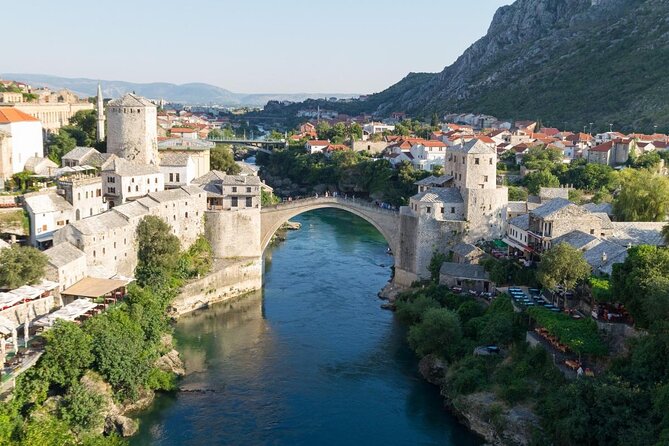
Of course, the Old Bridge is the headline. You stop at Mostar Old Bridge, the iconic crossing that became a symbol for the city across Europe and beyond.
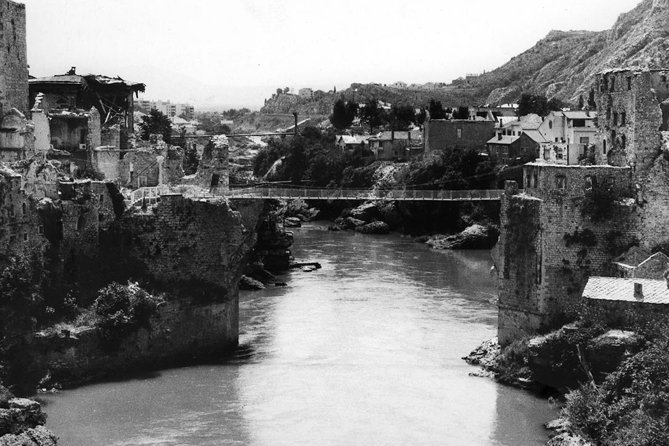
But the best part is the story you hear before you even start taking photos. You learn that when the Turks invaded Mostar, there was once a wooden bridge at this spot. It hung on chains, and crossing required caution. Later, the bridge was worn out by the mid 16th century, and Mostar asked authorities in Istanbul for a stronger replacement.
The bridge you see today was designed by Hajrudin, a pupil of the famous architect Sinan. It was completed and put into service in July or August 1566. You also get hard numbers that make the structure feel real: a span of 28.70 meters, a width of 4.49 meters, and a height of 21 meters from the summer water level. Construction details also stand out, including square stones connected with iron hooks and cast in lead.
A practical note: you will want a clear head here. If you rush, you miss how the Old Bridge anchors the old town’s forts, towers, and gates into a single architectural whole.
Another way to spend the day from here:
Mezarje Liska park, a green space that became a burial ground
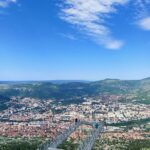
Next comes a pause that is visually calm and emotionally heavy. You visit Mezarje, also known as Groblje Liska park, a historic green space originally established in 1954.
During the 1992-1995 war, it became a burial site for civilians and soldiers from various nationalities. The reason was simple and painful: there were not enough available cemeteries at the time.
This stop is valuable for your understanding because it prevents the tour from turning into only dramatic bridge scenes. You see the human cost in a place that still functions as a park, which is exactly why it can be so difficult to process. If you prefer to keep things lighter, you might find this portion challenging.
I suggest giving yourself space here. Do not treat it like a quick photo spot. Let the guide’s pacing do the work.
Kujundziluk bazar, copper craft roots, and why people rebuilt businesses
After the burial site, the tour turns back toward daily life, which is an important emotional shift. You spend time in Bazar Kujundziluk, on the left bank of the Neretva.
The name comes from the coppersmiths, the Kujundžije, and the craft focus goes deeper than metal. The area also had many tailors and, in particular, tanners, known as great masters for processing leather. That is a big reason the streets feel “workshop real,” even when you are looking at souvenirs.
Today, Kujundziluk is known for small artisan workshops and handicrafts. For me, it is one of the smartest parts of the tour because it shows reconstruction beyond buildings. It shows people trying to restart skills, trades, and ways of earning a living.
If you want something useful to do afterward, this is where you can browse with purpose. You now understand why the craft mix matters, not just what is for sale.
Carinski Bridge and Kriva Ćuprija, the crossings most people miss
The Old Bridge gets the attention, but the tour also makes room for lesser-known river crossings that help you understand Mostar’s movement patterns.
You visit Carinski Bridge (Customs Bridge), spanning the Neretva River just north of the famous Old Bridge. This crossing is historically significant because it dates to the Austro-Hungarian period. The guide explains it as a vital crossing point connecting different parts of the city, which helps you see that Mostar was never only one bridge. It was always a network.
Then you reach the Crooked Bridge, Kriva Ćuprija. It sits in the old quarter and is easy to overlook if you only chase the postcard view. The tour frames it as a “miniature prototype” of the Old Bridge. It dates back to the 16th century and arches over the Radobolja River.
Even if you do not know the architectural terms, this stop makes sense the moment you look at it. It is a reminder that Mostar’s bridge identity is not a single object, it is a local design tradition.
The short film, and how it changes what you notice outside
One of the tour features is a short film about Mostar’s history. I like this kind of add-on because it acts like a mental tuning fork. When you watch something brief and focused before a sensitive walkthrough, you get fewer blanks in your understanding.
You will then notice details differently. You may catch how the Ottoman-era bridge story connects to the later city structure, and how the war-era memories influence what gets preserved versus replaced.
Keep your expectations realistic: a short film is not a full documentary. But for a 2 to 3 hour tour, it is a strong way to set context so the walk feels coherent, not random.
Price and what $47.66 really buys you
At $47.66 per person, this tour sits in the “you pay for a guide and emotional context” category. What makes it feel more like value than a tourist add-on is that you get:
- A professional authorized guide in English
- A private format where it is only your group
- A route that includes multiple major viewpoints plus a sensitive stop
- Included experiences like the short film
- Stops where admission is listed as free for the items specified
Duration is about 2 to 3 hours, so you are not spending an entire day. You also start and finish at the same meeting point near Spanish Square, so logistics stay simple.
If you are traveling with friends, keep in mind the operator lists group discounts. Since this is a private tour model, you may benefit if you are splitting costs with people outside your immediate household.
Pacing, emotions, and the kind of guide that makes it land
The strongest part of this tour is how your guide tells the story. In the experiences shared by others, guides described as friendly and flexible, and guides described as very informative, create an easy flow through tough material. That matters because the tour mixes striking architecture with personal war memory.
You should also expect the guide might share personal stories. Some accounts include memories from the war period when the guide was a teenager. That kind of detail does not turn the tour into a debate. It just gives the history a face.
If you are the type of traveler who wants neutral facts only, this might feel too personal. If you want context that connects buildings to people, you will likely find it meaningful.
Who this Mostar War Heritage Walking Tour fits best
This is a good choice if you want:
- War-era context without going full classroom mode
- A structured walking route that covers the key landmarks plus a sensitive stop
- Bridges, architecture, and human stories in the same morning or late morning
It is less ideal if you want a lightweight “quick highlights” tour with minimal emotion. The burial park stop and the war memories are not background noise, they are part of the point.
Book it or skip it: my practical take
I would book this tour if your Mostar plan includes time for more than the Old Bridge viewpoint. The combination of Stari Most, artisan Kujundziluk, and the war memory stops gives you a fuller city picture than many short excursions.
I would think twice if you are traveling with limited patience for heavy subject matter, or if you want a purely scenic loop. In that case, you might prefer a standard Old Bridge and town highlights walk.
If you do book it, aim for a calm mindset. Mostar is intense, and the tour works best when you let it.
FAQ
How long is the Mostar War Heritage Walking Tour?
It runs about 2 to 3 hours.
What time does the tour start, and where is the meeting point?
The start time is 9:00 am. The meeting point is Spanish square skate plaza (Španski trg, Mostar 88000).
Is the tour private, and is it in English?
Yes, it is a private tour/activity, meaning only your group participates. It is offered in English.
What’s included in the tour?
A professional authorized guide is included, and the tour includes a short film about Mostar’s history.
Is lunch included?
No, lunch is not included. An optional lunch is listed as not included.
What is the cancellation policy for a full refund?
You can cancel up to 24 hours in advance for a full refund. If you cancel less than 24 hours before the start time, the amount you paid will not be refunded.
More History Told Where It Happened in Mostar
- Mostar thru history -private tour
★ 4.9 · 43 reviews - Mostar gastro and historical treasures
★ 5.0 · 6 reviews - East Bosnia & West Serbia UNESCO heritage day tour from Sarajevo
★ 5.0 · 55 reviews - Sarajevo Full Day Tour: History, Culture, Nature, War & Olympics
★ 5.0 · 27 reviews
Most recently added near Mostar
- Going North and visit Sarajevo in a Day Tour from Mostar★ 5.0 · 1 review
- The Ottoman Experience Tour in Mostar★ 5.0 · 1 review
- Authentic Antique Museum Home★ 5.0 · 1 review
- Mostar: Private Walking Tour with Local Guide★ 4.0 · 1 review
- Top Secret Tito’s Bunker in a day tour from Mostar★ 5.0 · 1 review
- City Tour: Mostar Medival Town★ 5.0 · 1 review
- Wine Tour & Tasting (Herzegovina)★ 5.0 · 1 review
- Mostar Sunset Walking Tour with Wine Tasting★ 5.0 · 1 review
Historical Tours, compared.
East Bosnia & West Serbia UNESCO heritage day tour from Sarajevo
Read our review →
Sarajevo Full Day Tour: History, Culture, Nature, War & Olympics
Read our review →
Sarajevo genuine walking tour: Steps through history
Read our review →
SARAJEVO STREET ART TOUR (art, history & mystery) – sARTajevo!
Read our review →
BOSNIAN PYRAMIDS TOUR (nature, history & archeology)
Read our review →
Browse the lists this tour appears in